Personal Productivity

"How we spend our days is
how we spend our lives."
-Annie Dillard
Time management is really self management. We can’t manage time. We all have 24 hours a day. How we spend our time is the issue. All activities are not created equal. Some actions are wasteful, some actions are little more than ‘busyness’ and some actions move us forward. Below is a 5 step process for living life more intentionally.
1. Determine Your Purpose
Decide what is most important to you. Do you want to be a great father or mother, to serve God, be an effective leader? Do you want to get in shape, have a certain amount of money in savings at retirement or master an instrument? It is important that you clarity what you want. This is subjective and personal but very important. There is no right or wrong answer.
2. Define Your Goals
This is where you begin to quantify your purpose. Although not everything can be measurable, most things can be quantified. There are two types of goals: outcome goals and process goals. Both are important.
3. Develop a Master Task List (MTL)
It is important to get everything out of your head and on to paper. David Allen once said "Our minds are for having ideas, not holding them."
A Master Task List (MTL) is a comprehensive list of all the things you need and want to do: big and small, long and short term, professional and personal. Organize the list the way that works best for you. There is no right or wrong way. Some people like to categorize their list by roles such as: mother, nurse, Sunday School teacher, etc.
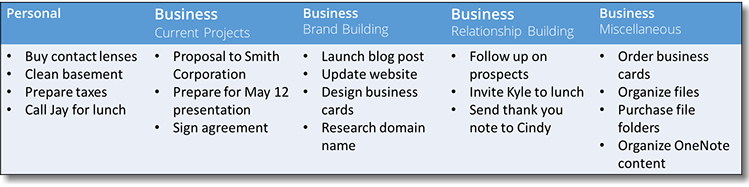
I break down my list into two major categories, personal and business. I further breakdown my business list into 4 sub-categories including current projects, brand building, relationship building and miscellaneous.
Here is an example of my current Master Task List (this is partial, not my complete list). Keep in mind that I use an app called Todo but pen and paper works great too. It is a matter of personal preference.
4. Design Your Week
Take 30 minutes each weekend to plan your upcoming week. This is similar to ‘zooming out’ on a map so you can see the big picture. Here you would add and delete items from your MTL, get a clear picture of your workload and schedule your priorities for the week.
5. Adjust Daily
As items come up during the week you will need to include many of them in your schedule. In addition to planning your week, take 5-10 minutes at the end of every day and plan the next day. This will let your mind absorb your plan overnight and get you off to a strong start in the morning.
Don’t Do List
Energy Cycle
Margin
Multitasking
Many things we spend time on are either of little value (mindless TV), negative (evening news) or something we have no control over (Middle East crisis). Limit your time on these things and concentrate on improving yourself and the lives of others.
Don’t be a slave to email. Turn the notification off and check it only at the times of the day that work for you and your job. It is important to respond to emails in a timely manner but constantly checking them is a time killer.
We all have high and low energy times during the day. As much as possible, plan your day according to your personal energy cycle. I am a morning person so I like to work on projects that need focus and concentration in the morning. I try to schedule appointments and meetings in the afternoon as well as work on shorter, more varied tasks.
Create ‘margin’ in your life. Don’t schedule every minute of your day. Make sure that you schedule ‘white space’ to allow for on the spot adjustments. Leave early for appointments. Set early deadlines for projects or deadline driven tasks. This will significantly reduce stress.
Constantly switching from one task to another is time consuming and hinders accuracy. As much as possible, do one thing at a time. Give each task the proper time frame and then focus without distractions for whatever time frame you set.


© 2016 Del Gilbert. All Rights Reserved.